


Developing Your IT Strategy: 7 Steps
.png)
If your IT strategy doesn’t suck, here’s how you’ll know:

Your IT supports everything your business wants to do.
You’re better than even your best competition.
Your CEO won’t land in compliance jail.
Good IT strategies align your company’s tech with your business ambitions and make the dream real. So, how do you build an IT strategy that actually works? Let us count the ways.
Your Step-by-Step Guide To Developing a Robust IT Strategy
1. Check Your IT Strategy Framework
Say what? An IT strategy framework isn’t an IT strategy. It’s a recipe for what goes into your strategy so that you can be confident you’ve covered all the bases. Here’s what to work on:
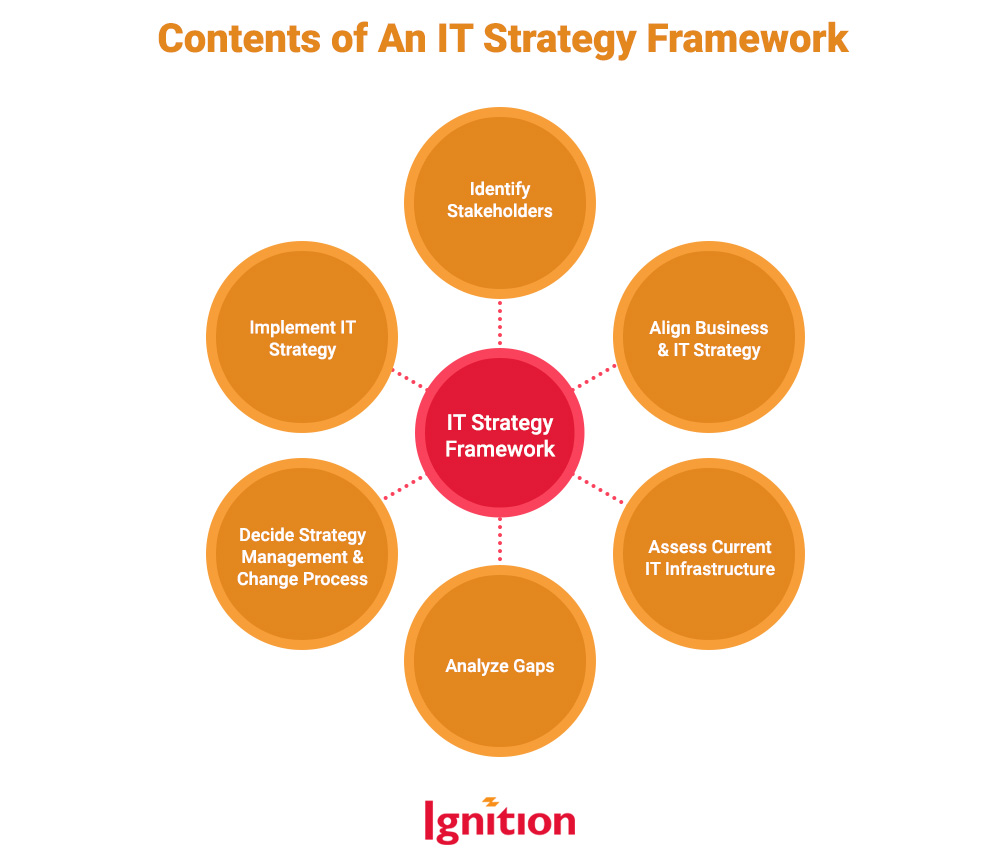
2. Identify Your Stakeholders
If your stakeholders are on board with your shiny new IT strategy, everything works better. Stakeholders are a strength - because they’re the ones affected by your strategy, interacting with them gives you more insight into what’s required of your strategy and may also win you their buy-in.
Buy-in relies on communication and understanding. Ramming an IT strategy down people’s pizza pipes won’t work. IT strategies don’t run themselves - people do. You need to identify who’ll a.) be affected by your strategy, b.) will put it into practice, or c.) both, and then gain buy-in, certainly within your business. Customers or suppliers will also be affected by your IT strategy and can be informed by them.
You’ll also need endorsement and support from the higher-ups (if you’re not one already) so you can send a clear, company-wide message that this is a priority.
3. Align Your IT Strategy With Your Business Goals
This step is kind of critical, otherwise, your IT strategy will be, at best, pointless and, at worst, destructive. If you’re a bit wooly about what the company goals are, a quick flick through the corporate brochure languishing in reception won’t cut it.
How To Identify Your Company Goals and Core Activities
Have conversations with the decision-makers. Think back to that flashy slideshow from the last team strategy sesh. What’s the target? And what’s the corporate roadmap for getting there? This’ll clue you in as to what kind of IT ecosystem you’ll need for support.
Take a special look at things like:
- Growth or expansion plans.
- Sales pipeline and targets.
- New markets, products, or services you’re developing.
- Current and future partnerships, acquisitions, or mergers.
4. Assess Your Current IT Ecosystem
Before you can create an IT ecosystem that’ll support your company goals, you’ll need to understand what you already have in place. This will help you identify the gaps and also where your current tech is already working well. Map out a clear picture of how your company’s architecture fits together (or doesn’t). It’s a good opportunity to identify the tech roadblocks and problems that are stopping your business from being super-brilliant. Things like:
- Bottlenecks in core business processes like workflow management & production, finance, and procurement.
- Poor customer experience or e-commerce glitches.
- Not-joined-up inventory management.
- Super-slow onboarding.
5. Cry Over Your Gap Analysis
Now that you’ve created a clear picture of what you have at the moment, is it fit for the purposes your business wants to achieve?
Ask yourself:
- What hardware, software, and other tools will we need if we’re to support company goals?
- Which parts of our current IT ecosystem aren’t working or are redundant? Create a list of all apps, systems, databases, networks, etc., you’re using - and analyze the pros and cons to determine which ones are best for your business.
- Assess each system for suitability concerning its security protocols and compliance assessments.
As you’re planning out how to close the gap between your current and your ideal IT ecosystem, gather data on what technologies are popular or useful in your industry and how other companies work with them. It’s sensible to learn from others.
6. Strategy Management and Change Process
Wait up, you haven’t even written your new IT strategy yet! No need to panic. A robust IT strategy doesn’t sit gathering dust bunnies on a shelf - it’s a living, breathing document that’s your One Source Of Truth for how you do IT. This means you’ll need to review it regularly to make sure it’s still fit for purpose. Deciding when, how, and who’s going to review your IT strategy and how it stays current with your business goals means it’ll always be relevant.
Technology is constantly evolving, and so are the laws and regulations that govern it. You’ll want to keep your strategy up-to-date for it to be effective. Remember that you’ll need to revisit your plan when any industry disruptions occur, when a new advancement in technology makes an entrance, or you identify changes in your customers’ demands, so factor all this into how you manage change.
7. Implement That IT Strategy
Now it’s time to put that IT strategy into action. What action you take will depend upon how you’re closing those gaps. It might mean:
- Adopting mobile device management (MDM) to speed up onboarding for scaling, going fully remote, or managing your IT assets more effectively. Or all three.
- Taking the first steps to become SOC 2 or HIPAA compliant by conducting a vulnerability assessment or hiring an auditor.
- Educating your team to be less useless at fighting off phishing attempts.
- Migrating fully to the cloud or introducing a new CRM system.
- Outsourcing aspects of IT to a managed service provider. (Ahem, that’s us).
Don’t be surprised if there’s a flurry of manic activity as you align your IT to better support your business goals.
Developing An IT Strategy Is Not For The Weak
When your head is up the butt of IT strategy development, it’s not always easy to remember why you’re doing it. Your IT strategy is there to do the grown-up stuff - sharpening your company’s competitive edge, serving your customers better as well as paying your mortgage. It’s important, so it’s okay to ask for help. That’s why we’d be almost too delighted if you’d pick up the phone to signal mayday. We’ve helped a ton of happy clients build IT strategies that supercharge their businesses (especially startups, but we’re not fussy). We’re here to help.
Ignition is Silicon Valley’s best (and friendliest) IT security, compliance, and support team. Contact us now – chatting about IT support and cybersecurity is our favorite thing to do!

Ignition (Laramie M) was super responsive -- I got an appointment right away and the issue was resolved in under 15 minutes. What could have been a frustrating process was seamlessly resolved. Thank you! Your company is very popular in our office!


