


5 IT Procurement Best Practices
.png)
If spending money on tech doesn’t give you a thrill in all the right places, then you’re doing it wrong. But you’ve worked hard for those IT dollars, so it seems fair to make sure they work hard for you. Now’s a good time to hit you up with five IT procurement best practices that’ll help you get the best value for your IT investment.
Wait Up, What’s Wrong With Just Buying IT Stuff I Need Willy-Nilly?
Seriously, why would you do that? String a few IT procurement best practices together and you’ll have a much better foundation for decision-making. Just check out this pretty diagram:
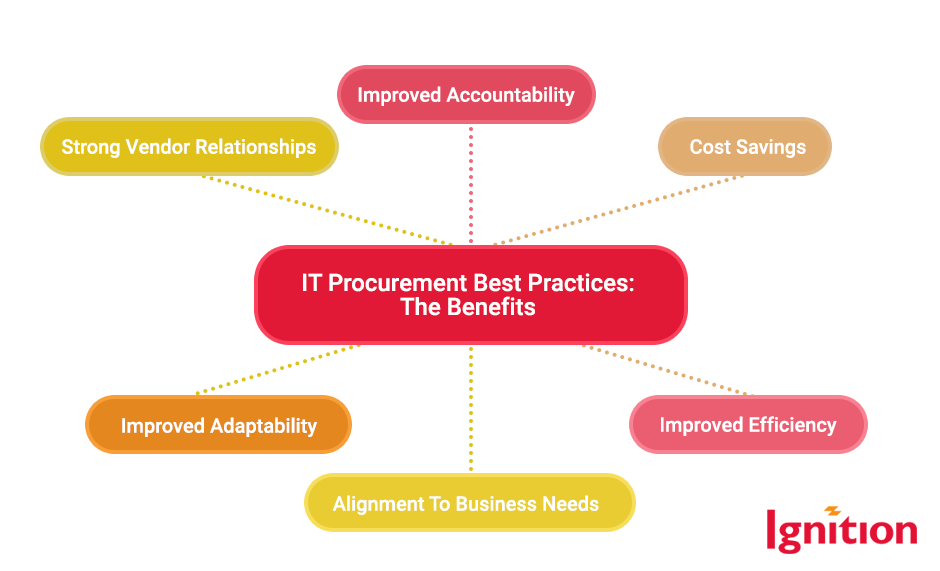
When you apply these best practices to your IT procurement decision-making, you’re looking at:
- Saving money through better negotiating, buying only what you need, reduced overstocking and improved asset management.
- Improving accountability by eliminating shadow purchasing.
- Improving efficiency by streamlining purchases, reducing delays and downtime.
- Aligning to business needs - no point buying stuff that doesn’t help your business goals.
- Improved adaptability by incorporating horizon-scanning and scalability into your purchasing decisions.
- Stronger vendor relationships, which can often mean better terms and better service.
Let’s dig in:
Best Practice 1: Check Out Your IT Procurement Strategy
Whaddya mean, you don’t got one? If you can’t find it hiding in your IT strategy, do yourself a solid and write one up this very minute!
Your IT procurement strategy makes buying so much easier because the decision-making is pretty much all done for you. It makes sure your IT purchases always, always, always support your business strategy. It means an end to maverick purchasing. It means that you always apply decent quality standards to what you buy.
Your IT procurement strategy is kind of like a shopping list for when you go to the store. Without it, you’ll buy a whole bunch of random stuff that looks good on the shelf, but when you get home a.) you’ve already got one, b.) it doesn’t work with what you already have, or c.) you could have gotten it cheaper online.
Best Practice 2: Define What You Need
If you already have an IT procurement strategy, the job’s mostly done. Be sure to consider areas of operations, security, and any special projects, like going fully remote, moving offices, increasing your headcount, or expanding into different markets. Are there new legal or security regulations for your industry?
Don’t forget to assess your current infrastructure - is some of it possibly antediluvian? Check your IT asset inventory for devices coming to the end of their natural lifecycles. Check out software licenses - got too many, not enough?
It’s important to look at how your IT ecosystem and team supports your business (or doesn’t) - consider if and what might be useful to outsource to a managed service provider (MSP) or something similar. Who says you have to do it all yourself?
Once you’ve defined your business needs, you’ll have a much better idea of what to buy.
Best Practice 3: Do The Math
If the word “budget” makes you feel deeply, deeply sad, tell your face to cheer up because your IT procurement budget is a framework that helps you make good purchasing decisions. Yes, of course you’d love your budget to be fatter and juicier, but having some numbers to play with gives you more than just purchasing power. Your budget is a way of:
- Prioritizing what you buy.
- Maximize the value of what you buy.
- Helping your stakeholders understand more about IT costs and benefits.
While budgeting is a best practice you need in your metaphorical procurement toolbox, it’s not the same thing as being a tightwad. IT is more about value than cost, and you mostly get what you pay for.
Best Practice 4: Build A Crew Of Decent Vendors
A good, reliable IT vendor is worth their weight in printer ink. That’s because, when you’ve got a solid relationship:
- You’ll communicate better. This means they’ll understand your business and your needs better - and this means their services are better tailored to you.
- Good clients receive priority service, and maybe even more favorable terms.
- You can stress less. You know they’re reliable, so they’ll deliver.
- You won’t need to chase them because you know they’re proactive.
- You get stable IT because a reliable service minimizes disruptions.
But how can you spot a decent vendor in the crowd of desperados crying, “Pick me, pick me!”? Check out reviews, and get recommendations from people who probably aren’t lying. When you talk to potential vendors, do they listen more than they speak? Do they try to understand your business? Do they seem open to problem-solving? Is their pricing transparent and easy to understand?
Best Practice 5: Borrow The Brains Of IT Procurement Specialists
OK, so we’re gonna say this because helping our clients source and choose the IT stuff that’ll help them achieve their goals is part of what we do. But just ‘cos we’re biased (and also honest) doesn’t mean it ain’t true.
IT procurement specialists can cover the whole remit of purchasing if you want them to - assessing your needs, sniffing out good vendors, doin’ the deal on your behalf and managing the procurement process. IT procurement specialists are especially useful if you’ve already got a clear picture of the end result you want (e.g., hiring remotely abroad, or scaling up headcount) but aren’t sure which tech and services can get you there.
IT Procurement Best Practices: How To Get Started
Improving how you do IT procurement requires deliberate thought, action, and a truckload of good change management. Making a start is often the hardest part - so why not make that start by grabbing a cuppa and having a think about the last three IT problems you had? Network fail? Breach incident? Massive software license bill you weren’t expecting? Looking at recent IT fails is often a way of starting to assess your business needs. Or - here’s something innovative - ask your people what sucks at the moment. It’s a way in. Another way in is to tippy-tap our number onto your keypad and have a chat with one of our friendly geeky-but-human team members. We’re here to help.
Ignition is Silicon Valley’s best (and friendliest) IT security, compliance, and support team. Contact us now – chatting about IT support and cybersecurity is our favorite thing to do!

Ignition (Laramie M) was super responsive -- I got an appointment right away and the issue was resolved in under 15 minutes. What could have been a frustrating process was seamlessly resolved. Thank you! Your company is very popular in our office!


